


Jul 26, 2019


Nov 10, 2018


Jul 28, 2018


Jul 15, 2018


Next time some culinary pedant officiously notes that tomatoes "are actually a fruit, you know," one-up them by asking what savoury dish is, in effect, a fruit salad. The basic recipe for ratatouille calls for courgettes, bell peppers, aubergines, tomatoes and onions. Only this last is not a fruit, although leave an onion long enough and it will start to produce roots and a stem. Never one to pass up a chance for pedantry, I will be referring to "fruit" throughout this post.

I often make ratatouille on Sunday evenings. It is a slow and simple dish which benefits from a couple of days in the fridge, so it's perfect to make in quantity and eat over the week. It lends itself to variation: four out of the five key ingredients will give you a reasonable approximation, although if you're missing the tomatoes you will need to replace the acid liquid with red wine, or vegetable stock and a few spoons of sherry vinegar. You can keep the flavours redolent of summer evenings in the south of France with thyme, garlic and marjoram; or sail along the Mediterranean with coriander, paprika, chilli or saffron.
Ratatouille is typically made on the hob, but I prefer to use the oven: first to roast the fruits; then to bake the combined dish into deep umami. I use tinned tomatoes because I have a personal bias against using fresh tomatoes in baked dishes: bland, watery winter tomatoes aren't worth eating in any form; whilst sunshine-soaked summer tomatoes are entirely perfect as they are. I like the visual effect of green courgettes, yellow peppers and red onions set against the dark aubergines and vivid tomatoes; but whatever colours you have will be fine.
The following recipe is simply a record of the ratatouille I made most recently. I change it every time, depending on the circumstances of my fridge and pantry. Ratios of aubergine, courgette, bell pepper and onion are entirely discretionary. You need enough tomato (or wine, or stock-plus-vinegar) to make a sauce, not so much you make a soup.
Make adjustments for where you add herbs to the recipe: hardier leaves like thyme, sage or rosemary can be roasted, more delicate leaves like parsley should be added at or even after the bake. But these are more what you'd call guidelines than actual rules. Break away.
Ingredients
2 aubergines
2 green courgettes
1 yellow bell pepper, 1 green bell pepper
2 red chillis
2 red onions, 2 white onions
1 bulb of garlic
Fresh thyme
Dried oregano
Dried basil
Dried chilli flakes
Paprika
1 tin of chopped tomatoes
Tomato puree
Red wine
Salt
Olive oil
Fresh lemon juice (for just before serving)
Method
Cut the aubergines, courgettes, bell peppers and onions into even sized chunks, but keep them separate. This allows you to roast each on its own terms, rather than risking burnt courgette alongside rubbery aubergine.
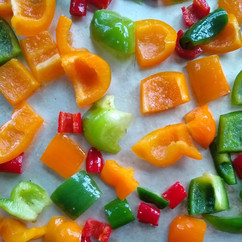
Toss the aubergines with olive oil, salt and oregano; the bell peppers with oil, salt and sliced red chillis; the courgettes with olive oil, salt and basil; and the onions with olive oil, salt and thyme. Roast each at 200 degrees, turning once or twice, until soft and browned. Turn the oven down by 20 degrees if they seem to be burning rather than browning.
Err on the side of caution with the salt: you can always add more later. However it does have a role beyond flavour: salt helps release water from the flesh and prevents the fruits from drying out whilst they caramelise at the high roasting temperature. Don't overcrowd the pan though - you're looking for tender, not wet. Much like the qualities one seeks in a man.

Whilst the roasting is ongoing, peel and roughly chop a bulb's worth of garlic - making the most of social-distancing. Gently fry the garlic in a dutch oven. If you don't have a hob-to-oven pot, you can skip frying the garlic to save on washing up.
Add all the roasted vegetables to the pot with the garlic, along with a tin of tomatoes, a slug of red wine, a generous squeeze of tomato puree, some paprika and chilli flakes and a swirl of good olive oil. Mix and taste. If it clearly needs salt, add some now. If in doubt, wait until it's cooked down.

Bake the ratatouille, uncovered, at around 150 degrees for anything between 45 minutes and two hours, depending on how deep you want the flavours, or how long you have until dinner. Give it a stir every 45 minutes or so.Taste again and add salt or a drop of sherry vinegar if you think it needs it.
The ratatouille can be eaten immediately, but it will be even better for cooling and reheating. A squeeze of lemon will restore any lost zing. Serve with pretty much any form of carbohydrate, but I like it best with baked potatoes.




Comments