


Jul 26, 2019


Nov 10, 2018


Jul 28, 2018


Jul 15, 2018


Everyone's cooking from scratch these days, and why not? We've got time, and mixing batters, rolling pastry and proving dough have a pleasingly first-world-dystopia vibe. Plus, a pandemic is a great time to try new things. Dough. Decoupage. Drinking alone.
I tried making pasta a few times when I was a teenager. The experiments met with marginally more success than my efforts with liquid eye-liner, which is to say I haven't attempted either within the last decade. But I'm 30 now. Time to conquer the fear!
Unfortunately, upon arrival at Sainsbury's, my post-apocalyptic fantasy was rudely forestalled by the actual absence of any flour whatsoever, let alone the Italian double 0 stuff upon which Nigella insists. Cursing banana bread under my breath, I trudged to the dried pasta and rice aisle, which had been bare for weeks. Peering round a few neglected tins of flageolet beans, I spotted a single packet of cannelloni pasta. I'd never made cannelloni. It looked time-consuming. Carpe diem. Carpe cannelloni.
The lack of flour also put paid to my plans to make pizza dough, but luckily this is a crisis where packets of Jus-Rol sourdough are still freely available. I resolved to spend the time saved on dough on a leisurely tomato sauce. I have spent the last two months Proust-ing about a gorgonzola-pear pizza I ate at the White Rabbit in Oxford back in February, and the butternut squash I needed to use up would go well with blue cheese. Sadly Sainsbury's only had gorgonzola dolce (nightmare, right) and as I wanted something sharper but with a creamy melting texture I went with Saint Agur.
Four-hour baked tomato sauce
A week before lock-down, I accidentally stockpiled a small mountain of tinned tomatoes thanks to a minor miscommunication about making salsa for fifty people. However, if you can get your hands on a few tins I thoroughly recommend making a vat of the following recipe. I'm sure it would freeze well, and it will taste better than anything you can possibly buy.
Ingredients
For the basic recipe, you will need one large white onion per tin of chopped tomatoes, double-concentrate tomato puree, olive oil, Worcestershire sauce, red wine, sherry vinegar, and salt.
You can take the sauce in a dozen directions depending on what flavours you mix in on top of this. For my purposes, I used oregano, because it reminds me of pizza whenever I smell it. I also used a fairly serious amount of chilli flakes. If you're not using chilli, at least grind in some black pepper to keep everyone awake. I also added crushed garlic cloves (use more or less depending on whether you want to push the garlic to the front, or allow it to lurk in the background). Personally, I don't much like the flavour of dried basil, but you do you.
Method
Use a Le Creuset style hob-safe dutch oven if you have one, to save on washing up. Or don't, to waste time.
Dice and fry the onions in oil until they are translucent and lose all resistance when you bite into them. This should take around 20 minutes. If they seem to be turning brown faster than they are softening, add a splash of water. Garlic has a much lower burning point than onion so wait until the onions are pretty much done before frying the garlic.
Add the tinned tomatoes, red wine (probably don't exceed a 4:1 ratio of tomatoes to wine, but let me know the results if you do), tomato puree, Worcestershire sauce, some salt, and whatever herbs you're using. Simmer this on the hob until the tomatoes have begun to fall apart. Transfer the mixture to a food processor or use a stick blender and blitz until smooth. This will take longer than you think it will. Keep going. Then some more.
Back on the hob, add a glug of olive oil (the good stuff: it's for flavour) and simmer the mixture until it coats the back of a metal spoon thickly and evenly. Taste and adjust the salt and acidity: use more Worcestershire sauce if you want to add umami along with the salt; add sherry vinegar by the half teaspoon, stir and taste again.
When you are happy with the flavour, transfer the pot to a low oven at around 140-150 degrees. I left the sauce uncovered to facilitate browning: this is where the seriously deep umami flavours will develop. Leave it for an hour, fold the developing crust back into the sauce, and bake for another hour. It should begin to resemble a thermal mud pool, with slow, sticky bubbles of sauce bursting every few seconds.
From here, check and stir the sauce every half hour or so until it has reduced to a density which defies the heat energy from the oven. At a rough estimate, this took mine three and half hours.
Use the sauce immediately, refrigerate or freeze. If you are using it later, add a squeeze of fresh lemon juice to wake the flavours up.
Butternut squash and blue cheese pizza
Given the whole Jus-Rol situation, a recipe feels somewhat superfluous. But if you roll out the dough you have either bought or lovingly hand-crafted, spread it with tomato sauce and cover it in liberal amounts of mozzarella, roasted butternut squash, and Saint Agur you will have a very delicious Friday night dinner. Quick, too.
Butternut squash cannelloni
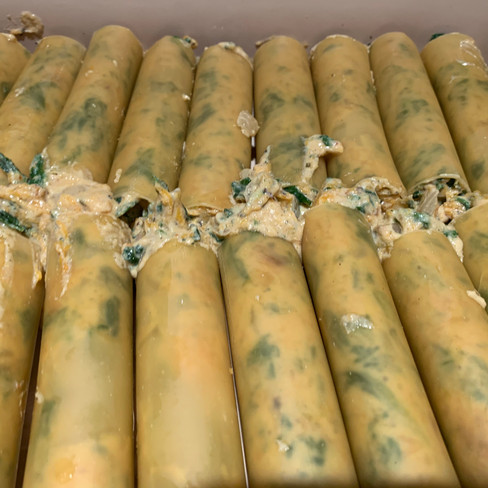
Spinach and ricotta is my go-to pasta filling, and I thought it would combine well enough with the squash mellowing in my fridge. I squished together the remaining squash, lots of defrosted spinach, ricotta, lemon zest, lemon juice, a couple of eggs and some salt and pepper and piped the mixture into the cannelloni.
Confession time: I was totally going to use the tomato sauce to cover the pasta, but I had Saint Agur left over from the pizza and I was so taken by the combination with the butternut squash I made a blue roux instead. I blanketed the pasta in sauce and baked it for about 40 minutes.
This was pretty good, but slightly on the dry side. Using the tomato sauce would doubtless improve matters. However I really liked the concept of cannelloni as an alternative to lasagne, and I'll take any opportunity to get out a piping bad, so I'll definitely be trying this again.




Comments