


Jul 26, 2019


Nov 10, 2018


Jul 28, 2018


Jul 15, 2018


I am a very easy dinner party guest.* I have no allergies, intolerances or strong aversions to any food. But in 2018, it is rare to cook a meal for more than four people and not have to take some sort of exclusion into account.
I made a version of this - entirely vegan - pasta bake for a party last winter. It was a big hit, but I hadn't kept note of what I was doing, so when asked for the recipe I probably muttered something vague about an oil-based roux. When I went to stay with a vegan friend last Friday I decided to have another go.
*I take no responsibility for my actions in the presence of under-seasoned food.
There's something about pasta, especially when smothered in a thick blanket of cream, tomato, or cream-and-tomato sauce, that makes me feel very autumnal. Perhaps it's the sense of storing up a belly for winter hibernation. A good pasta bake, liberally scattered with cheese, constrasts squashy, savoury comfort beneath with a salty, caramelised crunch. The challenge with a vegan pasta bake is finding a way to create these textures and tastes using only plants.
I like chestnuts: naturally sweet and almost fudgy when whole; when pureed they make a beautiful base for a sauce. One can - and I have, and you should - buy them in pouches, already cooked and shelled, or in tins as a puree. However when I went to buy them, the only type available were the sort one is supposed to cook oneself. An hour later I found myself standing in the kitchen, knife in hand, grumpily googling "Do you actually have to put crosses in chestnuts?" In the process I found this article which mentioned boiling, rather than roasting, to keep them more tender. As I wanted to puree them, this seemed like a good move, so I cooked them in salted water for half an hour. Peeling the chestnuts was rather hit and miss: irritatingly, several of them had black areas which needed to be cut away; and while a few detached themselves cleanly from the inner skin, most of them did not.
After peeling as best I could, I used a food processor to puree the chestnuts with unsweetened almond milk. I began to sieve the mixture to remove the pieces of skin, before realising that the undoubtedly more refined texture (photo with spoon) was not worth my time, and stirring everything back together.
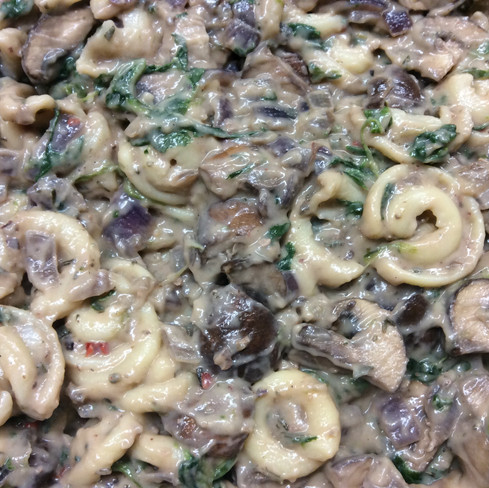
For the main body of the bake, I fried finely diced red onions with pieces of chestnut mushroom; plus minced red chilli, sage, rosemary and lots of garlic. I cut the mushrooms into fairly large chunks: they shrink during cooking and I wanted a textural equivalent to pieces of chicken. I chose chestnut mushrooms only because I liked how their name went with the nuts I was using. Standard white mushrooms would have been fine, as would whole baby mushrooms. They did not caramelise much during frying: cooking in smaller batches would have helped with this. I threw in some frozen spinach at the end, because #vegan.
I began to make a roux, using plain flour and olive oil instead of the normal butter. I added finely chopped rosemary and sage, and sea salt. Once the flour was cooked, I added almond milk a splash at a time, beating it into the roux with each addition, until it had become a thick, smooth sauce.
I stirred in the chestnut puree and kept the sauce over a low heat, stirring occasionally, while I boiled the pasta. I used dischi volanti pasta, because I like the way the shape picks up lots of the sauce, looks kind of mushroomy, and lies reasonably flat, giving an even top to the bake. I'm not someone who goes in for "al dente" pasta: all too often that simply means undercooked. However, with the second round of heat, pasta intended for baking really should be drained before it is completely soft. I added two ladles' worth of the pasta water to the sauce to thin it down.
I combined the mushroom and red onion mixture with the sauce, then added the pasta and stirred everything together. At this point I realised I had neglected to include acid at any point: and while the sauce was fabulously creamy, the whole thing was verging on stolid. It was too late to add wine, so I added a very small amount of sherry vinegar. I did not want to be able to detect the pungency of the vinegar; only for the acidity to lift the dish. I could also have used lemon juice. However next time I will try to remember to add a big glug of white wine to the sauce while it's cooking.
The cheesy surface of a pasta bake, bubbling dark gold as it emerges from the oven, is my favourite part. I needed to have a really excellent topping to make up for the lack of cheese. As I had used almond milk, I decided to use flaked almonds to provide the crunchy texture; toasting the almonds first would also help provide those caramelised notes. Along with the almonds, I toasted rosemary and sage. Once cooked, I roughly chopped everything together, and added a large pinch of crunchy Maldon sea salt.
I think pasta bakes work best in shallow dishes: they give a higher ratio of topping. However my one truly portable baking dish (pyrex, with a watertight lid) is quite deep, so that's what I took to my friend. At home I got the better deal: the pasta spread about two inches thick, with a good layer of almond rubble. I baked it at 180 degrees for about 25 minutes.

I was broadly pleased with how this turned out. The flavours all worked well together, and I definitely didn't miss the dairy. The topping was great, and I liked the size of the mushrooms. As mentioned above, next time I would add wine to the sauce as it cooked; and perhaps make more effort to caramelise the mushrooms. I haven't discussed amounts or ratios here, but I think it might have been better with more, or thinner, sauce relative to the amount of vegetables.




Comments