


Jul 26, 2019


Nov 10, 2018


Jul 28, 2018


Jul 15, 2018


I was invited by a cricket-obsessed friend to go to Lord's for Ladies Day, with the specific proviso that I must make picnic food. What's more picnicky than Scotch eggs?
I had never made them before and as usual when trying out a new food I checked whether Felicity Cloake had anything to say on the subject. I love her How to cook the perfect... Guardian column, testing out a variety of recipes before combining her favourite elements to make the perfect... well, in this case, Scotch Egg. Ms Cloake talks through her reasons for preferring one to another, encouraging the reader to fiddle around and make adjustments based on what flavours they like, or have to hand. Ideal for people who can't stick to recipes.
Eggs
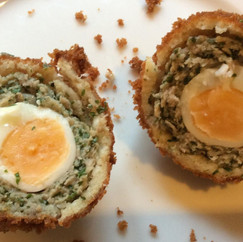
Armed with Ms Cloake's research, I decided to use quail eggs rather than chicken eggs. Because cute = winning picnic food. I bought two packs of quail eggs, because one didn't look like enough. In the event, 24 turned out to be quite a lot.
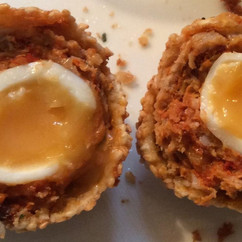
I lowered the quail eggs into salted boiling water for two minutes; six at a time so I could get them all in and out within seconds of each other. From the boiling water I plunged them straight into an ice bath to stop the cooking process. No one likes an overcooked yolk. When they were cold I peeled them - trickier than usual as the whites were only just set - and rolled them in cornflour.
Meat

While waiting for the eggs to cool I mixed up the sausage meat. As per Ms Cloake's advice I combined pork mince with sausage meat, and the quantities available in the shop meant I ended up with 850g of meat in total. By happy coincidence this worked perfectly for 24 quails eggs.
I had already decided I was going to do 12 "traditional" and 12 "something else". I divided the meat mix in half and added fresh sage, thyme and lots of fresh parsley, with smoked salt, to one bowl; and paprika, cayenne pepper and seasalt to the other. I often find flavouring meat a little difficult, in that you really can't taste anything until after its cooked. I picked these combinations based on a mental Venn Diagram of herbs and spices that go well with both pork and egg.
Assembly
I divided each bowl of meat into 12 equal pieces, then rolled these into balls before squashing them into rectangles about 5mm thick. I took a cornfloured egg and rolled the sausagemeat around it, pinching the gaps and smoothing as much as possible. This turned out to be vital in the frying process: weak points split apart and resulted in some rather sorry-looking eggs. Which I ate. So not all bad.
For the traditional eggs, I would have followed Ms Cloake's suggestion of using panko breadcrumbs, but I didn't have any. Instead I simply whizzed up some normal sandwich bread to make crumbs. I put these into one bowl, with a second bowl of cornflour and a third of egg beaten with a good grind of salt and a splash of milk. I rolled each sausage ball in cornflour, then egg, then breadcrumbs, back to egg, more breadcrumbs. They looked pretty good. And surprisingly large: I was suddenly very grateful I had chosen to do quail eggs.

I needed to differentiate the spicy paprika eggs somehow. Rummaging through the cupboard I found most of a packet of sesame seeds. I decided to go the whole hog and coat these eggs completely with seeds in place of breadcrumbs. The seeds only needed one coat to get a good layer so I did two coats of cornflour instead: cornflour, beaten egg, cornflour, beaten egg, sesame seeds.
Cooking

Ms Cloake suggests frying the Scotch eggs for seven minutes. For the smaller quail eggs I decided to knock off one minute - the sausage meat still needs to cook in the time. I don't own a deep fat fryer so I filled a large saucepan about 7cm deep with rapeseed oil and heated it to 170 degrees. I did a test one which came out beautifully, so I cooked all the eggs in batches of three for six minutes each.
Without a deep fat fryer I had to keep an eye on the temperature of the oil, which would occasionally spike or drop for no apparent reason. Keeping the oil bubbling at between 170 and 180 degrees allowed the Scotch eggs to cook quickly, without absorbing too much of the oil, and without burning.
I popped the eggs on wire racks over kitchen roll to dry and cool.

With hindsight, 24 eggs was a lot of effort. The traditional ones worked well, although I think I might make a special effort to get panko breadcrumbs to keep the crispiness going - although beautifully crunchy out of the fryer by the time I got them to the picnic the breadcrumbs had inevitably softened. The sesame seed coating also worked well for something a bit different, but perhaps wasn't a completely natural pairing for the paprika. It could work well with chilli and ginger for a proper kick of spice, possibly with some honey stirred into the mix.
Either way, the main test of success was met: they all got eaten.
Dietary adaptations
Milk-free: do not add milk to the beaten egg.
Gluten-free: remove the meat from gluten free sausages or just use pork mince. Make the breadcrumbs from gluten-free bread or try the sesame seed coating.
Ideas for further experimentation
Chilli, ginger and honey with sesame seed coating.
Black pudding (well, obviously).
Haggis - perhaps with an oat coating.




Comments